
Industrial safety equipment plays a critical role in protecting workers across sectors like construction, manufacturing, oil & gas, and logistics. In India, ensuring the quality and reliability of such equipment is mandatory, and this is achieved through certification by the Bureau of Indian Standards (BIS).
This blog explains the certification process, requirements, and importance of compliance for industrial safety equipment in India.
Why Certification is Important
Certification ensures that safety equipment meets defined quality, performance, and safety standards. It helps:
Protect workers from hazards
Ensure legal compliance
Improve product credibility in the market
Build trust among industries and buyers
In many cases, certification is mandatory under government-issued Quality Control Orders (QCOs).
Key Certification Authority in India
Bureau of Indian Standards (BIS)
The BIS is the national body responsible for setting and enforcing standards in India. Products that meet BIS standards are allowed to carry the ISI Mark, which confirms compliance with safety and quality requirements.
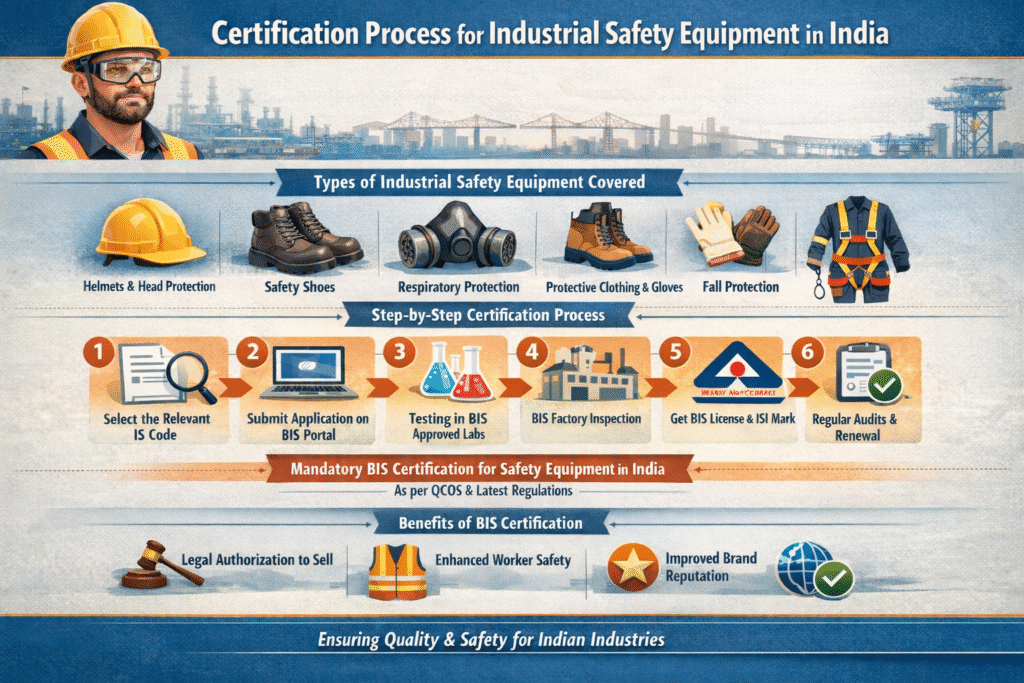
Types of Industrial Safety Equipment Covered
Industrial safety equipment includes:
- Helmets and head protection
- Safety shoes and footwear
- Respiratory protection (masks, filters)
- Protective clothing and gloves
- Fall protection systems
For example, respiratory masks must comply with IS 9473 standards, ensuring filtration efficiency and safety performance.
Similarly, safety footwear must follow IS 15298 standards aligned with international norms.
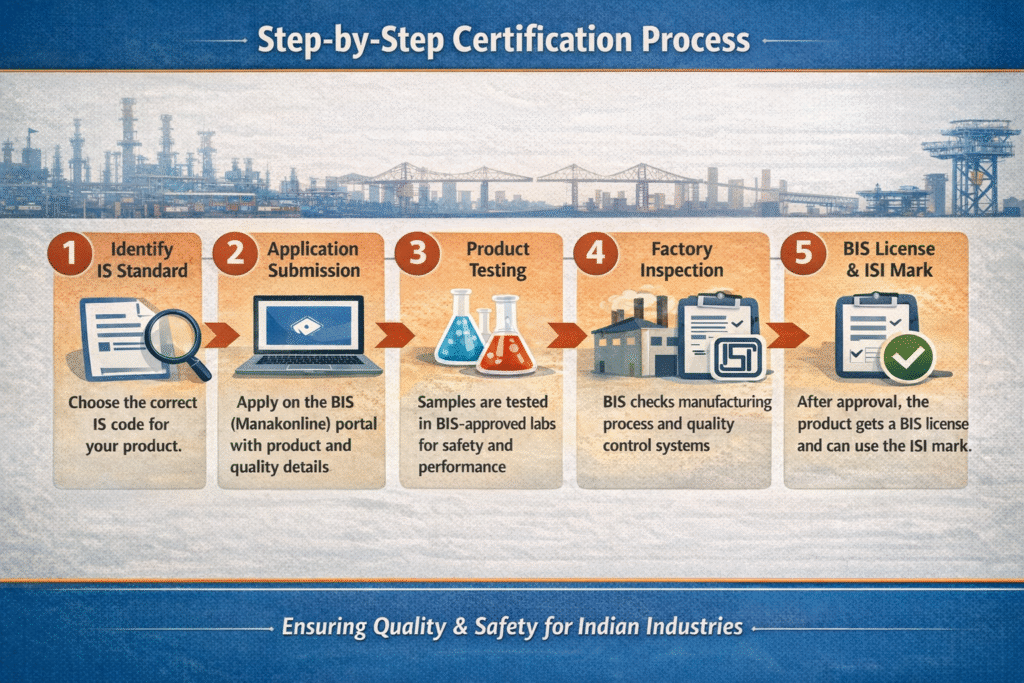
Step-by-Step Certification Process
- Identify IS Standard
Choose the correct IS code for your product. - Application Submission
Apply on the BIS (Manakonline) portal with product and quality details. - Product Testing
Samples are tested in BIS-approved labs for safety and performance. - Factory Inspection
BIS checks manufacturing process and quality control systems. - BIS License & ISI Mark
After approval, the product gets a BIS license and can use the ISI mark. - Surveillance & Renewal
Regular audits ensure continued compliance; non-compliance can cancel the license.
Mandatory Certification for Industrial Equipment
Under recent regulations like the Machinery and Electrical Equipment Safety (Omnibus Technical Regulation) Order, 2024, many industrial machines and safety-related equipment must obtain BIS certification before being sold in India.
Benefits of BIS Certification
- Legal authorization to sell in India
- Enhanced worker safety
- Improved brand reputation
- Competitive advantage in the market
- Compliance with international standards
Conclusion
The certification process for industrial safety equipment in India is essential to ensure product quality and worker safety. By complying with BIS standards and obtaining the ISI mark, manufacturers and suppliers can meet legal requirements and build trust in the market.
For any business dealing with industrial safety equipment, understanding and following the certification process is not just a legal obligation—but a responsibility toward safety and reliability.