
When international buyers source safety equipment, PPE, first-aid kits, emergency products or industrial protective gear, price is only one part of the decision. Buyers also want confidence that the supplier follows recognised quality systems, provides correct product documentation and can support the compliance requirements of the destination market. Terms such as ISO certified, CE marked and WHO compliant are often used during procurement, but they do not mean the same thing. Understanding the difference helps buyers evaluate suppliers more accurately before placing a bulk order.
Why Compliance Matters to International Buyers
Safety equipment is used in factories, construction sites, warehouses, healthcare facilities, marine operations and other high-risk environments. Because product performance can directly affect worker safety, professional buyers usually check more than the catalogue. They may ask for company certifications, product test reports, technical specifications, declarations of conformity, batch information and packaging details. A supplier that can provide organised and verifiable documentation is easier to approve for long-term procurement.
ISO Certification
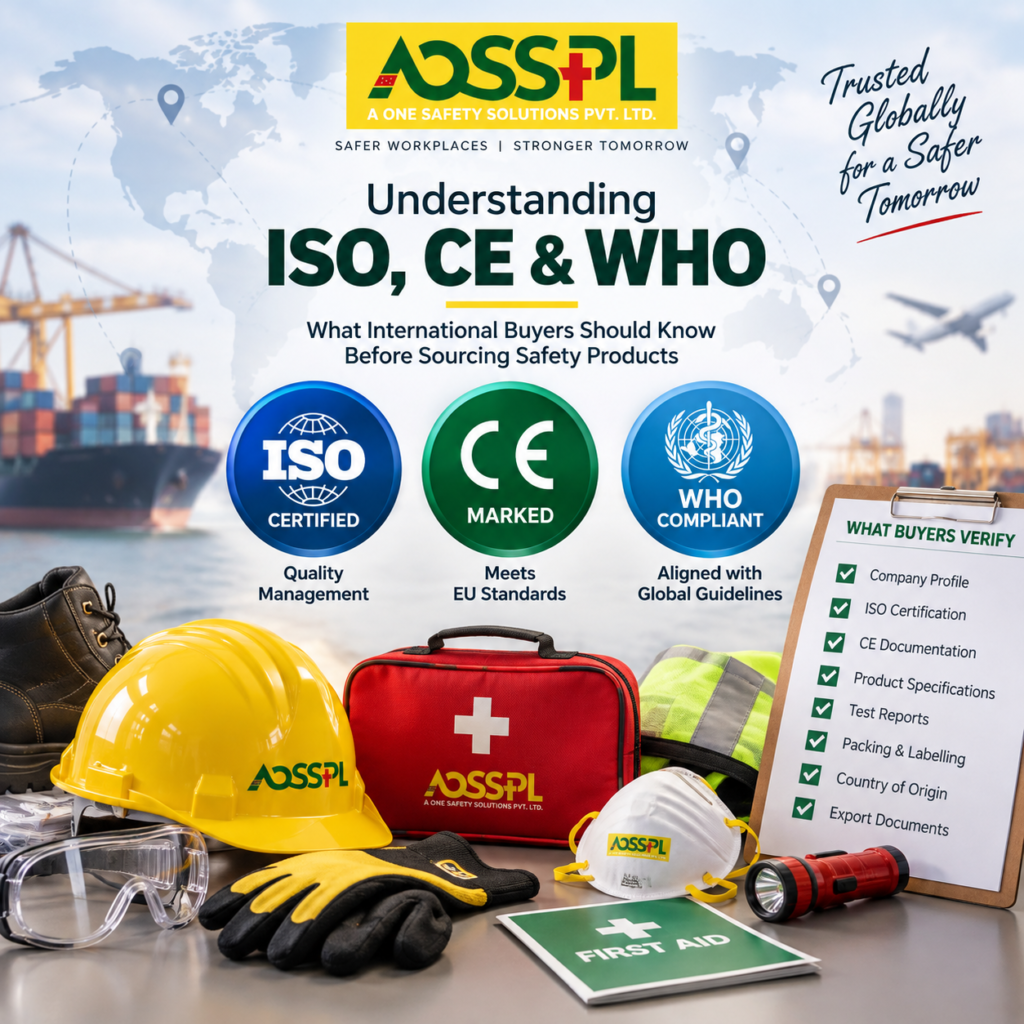
ISO standards are internationally recognised benchmarks used by organisations to improve quality, safety and management systems. One of the most common certifications seen in manufacturing is ISO 9001, which relates to quality management systems. For buyers, ISO 9001 certification can indicate that the company has established processes for quality control, documentation, corrective action and customer requirements.
However, buyers should remember that ISO 9001 is a management-system certification. It does not automatically mean that every product made by the company is individually certified. Buyers should check the certificate number, validity period, certification body, company name, manufacturing location and scope of certification.
CE Marking
CE marking is important for products that fall under relevant European Union legislation. For applicable personal protective equipment, the manufacturer must meet the required conformity-assessment process before the product can be placed on the European market. Depending on the PPE category, third-party assessment may also be required.
International buyers may therefore ask for the EU Declaration of Conformity, applicable test reports, technical documentation and notified-body details where required. A CE mark should be connected to the specific product and applicable regulation rather than treated as a general company certificate.
WHO Compliance and Guidance
WHO publishes technical specifications and procurement guidance for certain medical and protective products. Therefore, a claim such as WHO compliant should be supported by relevant product specifications, test data or technical documentation. Buyers should avoid treating WHO compliance as a general product certificate and instead verify exactly which WHO specification or guidance the supplier is referring to.
What Buyers Should Verify Before a Bulk Order
- Company profile and manufacturing details
- Valid ISO certification where applicable
- CE documentation for relevant products
- Product specifications and test reports
- Packing and labelling details
- Country of origin and export documents
- Sample approval before mass production
Conclusion
ISO certification, CE marking and WHO guidance each serve different purposes in international safety-equipment procurement. The strongest suppliers are not those that simply display certification logos, but those that can provide clear and verifiable supporting documents. For AOSSPL and other safety-equipment exporters, transparent documentation can help build buyer confidence, reduce compliance questions and support long-term international business relationships.
Frequently Asked Questions
No. Requirements depend on the product, buyer, destination market and tender conditions, although ISO-based quality systems can strengthen supplier credibility.
No. CE marking applies only to products covered by relevant European legislation.
Yes. Buyers should check validity, scope, company details and whether the document applies to the specific product being purchased.