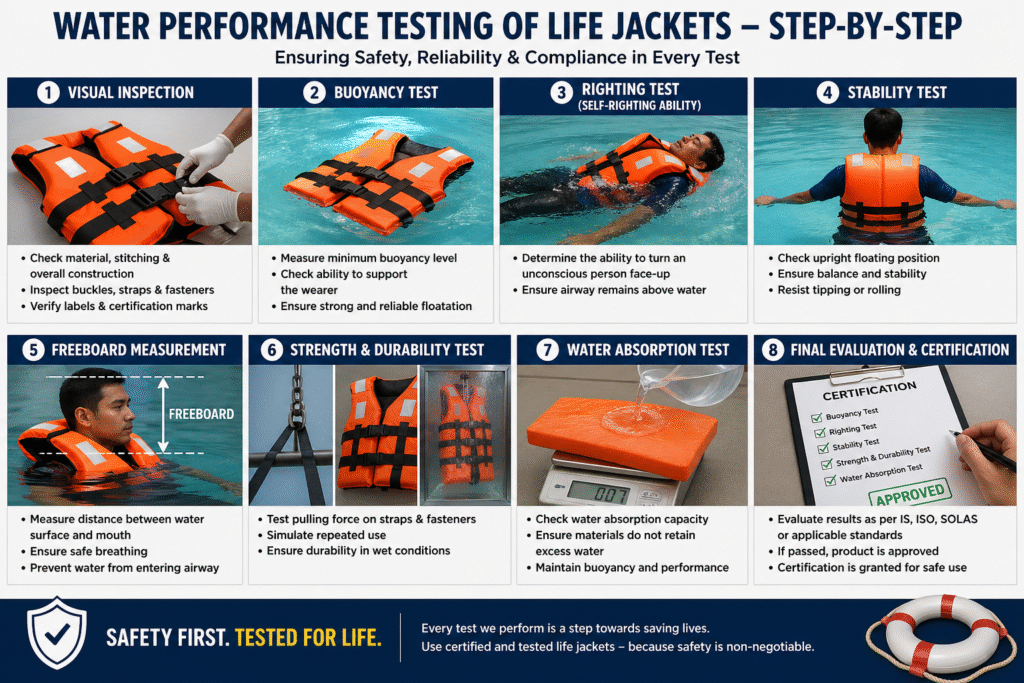
Water Performance Testing of Life Jackets – Step-by-Step
Life jackets are critical safety devices used in marine, industrial, and rescue operations. To ensure they perform effectively in real-life situations, water performance testing is conducted under controlled conditions. This testing verifies buoyancy, stability, and reliability in water.
Below is a step-by-step overview of how life jackets are tested for water performance.
1. Visual Inspection
Before water testing begins, the life jacket is checked for:
Material quality and stitching
Buckles, straps, and fasteners
Proper labeling and certification marks
This ensures there are no visible defects that could affect performance.
2. Buoyancy Test
The life jacket is placed in water to measure its ability to float and support weight.
What is checked:
Minimum buoyancy level
Ability to keep the wearer afloat
This is one of the most important tests for safety compliance.
3. Righting Test (Self-Righting Ability)
This test checks whether the life jacket can turn an unconscious person face-up in water.
Purpose:
Ensure airway remains above water
Prevent drowning in emergency situations
4. Stability Test
The life jacket is tested for balance and stability in water.
What is checked:
Upright floating position
Resistance to tipping or rolling
5. Freeboard Measurement
Freeboard is the distance between the water surface and the wearer’s mouth.
Why it matters:
Ensures safe breathing
Prevents water from entering the airway
6. Strength & Durability Test
The life jacket is subjected to stress conditions like:
Pulling force on straps
Repeated use simulation
Water exposure over time
This ensures long-term reliability.
7. Water Absorption Test
Materials are tested to ensure they do not absorb excess water, which can reduce buoyancy.
8. Final Evaluation & Certification
After all tests, results are evaluated as per safety standards (such as IS, ISO, or SOLAS).
If the life jacket passes:
It is approved for use
Certification is granted
Conclusion
Water performance testing of life jackets is essential to ensure maximum safety in emergency situations. From buoyancy to stability and durability, every test plays a crucial role in saving lives.
Using certified and properly tested life jackets is not just a requirement—it’s a lifesaving necessity.